AI Agents Can Take Action. Who Controls Their Access?
ServiceNow’s AI Passport aims to give AI agents verifiable identities and enforceable limits on what they can access and do.

AI agents aren't just answering questions and summarizing documents. They are beginning to take action inside enterprise systems.
As agents increasingly become part of daily business operations, IT leaders face the task of figuring out what exactly an AI agent should be allowed to do.
ServiceNow is attempting to address that issue with AI Passport, a new capability within its Control Tower designed to establish and enforce what an AI agent is authorized to access and what actions it can perform.
The company's announcement this week comes as more organizations move autonomous agents from pilots into production.
"You can't control what you can't identify, and you can't govern what you can't see," Nenshad Bardoliwalla, senior vice president of AI products at ServiceNow, said during a press briefing ahead of the announcement.
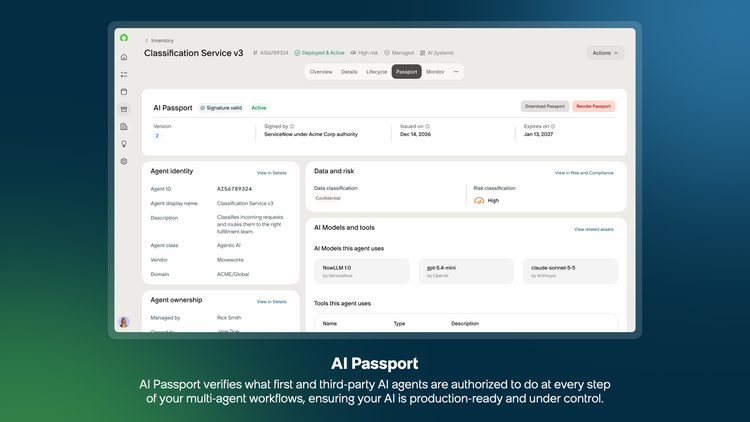
(Screenshot of AI Passport. Image: ServiceNow)
Visibility into what AI is actually doing inside an organization is a top concern for midmarket IT leaders, as evidenced by discussions and sessions at this year's MES Fall event. It is a concern that goes beyond any single platform or implementation.
"Just because you have dashboards doesn't mean you have observability," said Nick Phelps, field CTO at Congruity30, during a recent discussion about AI infrastructure, data governance and security.
As Phelps suggested, visibility on its own only gets IT teams so far into truly understanding AI systems.
As agents gain access to enterprise data, applications and business processes, organizations also need a way to define the boundaries of their authority before they take action.
Giving AI Agents Boundaries
AI Passport provides an agent with a verifiable identity tied to governance rules defining what systems it can access, what actions it is authorized to perform, and who is accountable for it. ServiceNow says those rules travel with the agent across systems and vendors, while AI Control Tower can detect when an agent moves outside its authorized boundaries.
The concept was demonstrated during the ServiceNow press briefing:
An AI agent responsible for handling customer refunds was given authority to automatically process refunds of less than $25. When an $18 refund request came through, the agent was permitted to complete the transaction. When a $40 request arrived, the action was rejected at runtime because it exceeded the established limit for automatic processing and required human review.
It's a simple example but illustrates a big issue IT leaders face as agentic AI enters production.
Traditional AI governance has often focused on questions such as which models an organization should use, what data those models can access and whether an AI application is sanctioned by IT. Autonomous agents require another layer of insight—knowing what decisions and actions AI is authorized to make.
[RELATED: Strata Identity Announces New Way To Manage AI Agent Logins]
That distinction becomes critical when dealing with agents that can do more than output answers.
Why A Kill Switch Isn't Enough
ServiceNow's approach also challenges the idea that governing autonomous AI simply requires giving IT the ability to shut an agent down.
Real governance is more graduated than an on/off switch, Bardoliwalla said. Organizations may want to monitor an agent, pause it, restrict its capabilities, or ultimately deactivate it. But enforcing those controls requires an established baseline defining what the agent was authorized to do in the first place.
Human oversight doesn't disappear in that model.
During the briefing, Bardoliwalla said many customers are likely to begin with human approval and allow greater autonomy only after an AI system meets an organization's governance criteria and evaluation requirements. Even then, he said, organizations should retain a path back to human intervention.
For IT leaders, that suggests agent governance is starting to look less like giving an AI tool permission to operate and more like identity and access management (IAM): establishing an identity, determining its privileges and managing levels of delegated authority, just as organizations do with human users.
In IAM terms, agents effectively introduce a new class of non-human identity whose permissions may need to change according to the task they are performing.
The Third-Party Agent Problem
The issue gets more complex when organizations use agents from multiple vendors.
ServiceNow says AI Passport is not limited to AI agents created on its own platform. Bardoliwalla said the company wants the technology to apply to third-party agents as well and sees potential for the passport concept to become an industry standard.
That claim will matter for IT organizations already dealing with multiple AI providers.
Asked during the briefing why organizations should manage agent identity and authority at the ServiceNow orchestration layer rather than rely solely on existing identity providers, Bardoliwalla said AI Control Tower combines discovery, observability, governance, security, cost and value measurement. It also draws on the organizational context contained in ServiceNow's configuration management database.
The question is particularly relevant following ServiceNow's move to acquire identity security provider Veza, which the company positioned as part of its strategy for governing human, machine and AI identities.
[RELATED: ServiceNow Says It’s ‘Perfectly Positioned’ For Midmarket As Veza Deal Announced]
Of course, that's ServiceNow's pitch. But the question itself is one IT leaders are increasingly going to have to answer: Where should control over AI agents actually live?
[RELATED: ServiceNow’s New Zurich Release Is Its Ode To The Agentic Era]
Shadow AI Meets Agent Sprawl
For NTT Data, a global technology services and consulting firm, AI governance is already tied to another problem familiar to IT: shadow technology.
A representative from NTT Data described the company as having approximately 660,000 employees across more than 70 countries and roughly 2,500 applications accumulated through acquisitions and other sources. The organization uses AI Control Tower as part of an effort to gain visibility into AI tools and use cases across that complex environment.
The challenge isn't just determining whether AI has been approved. NTT Data is also looking for duplicated use cases as well as AI tools doing similar jobs, which can contribute to additional spending and inconsistent user experiences.
And that may be where the AI passport announcement becomes most relevant for midmarket IT leaders.
The arrival of autonomous agents does not eliminate the familiar problems of identity, access, shadow IT, cost control and accountability. It potentially brings all of those problems together in software that can increasingly take actions on the organization's behalf.