You Say Cost Control, I Say Productivity: The UK-US AI Divide
US midmarket organisations are spending more, deploying AI more aggressively and are more optimistic about 2027 than their UK counterparts.

A comparison of Computing's UK IT Intent survey with MES Computing's US research reveals a distinct pattern: Mid-size American organisations are spending more, deploying AI more aggressively and expressing greater confidence about the year ahead, while UK SMEs remain more focused on cost control and stability.
IT leaders on both sides of the Atlantic have a shared agenda of using technology to serve the needs of the business over the next year and beyond, with priorities including managing AI rollouts, boosting cybersecurity and keeping costs under control.
However, a comparison of Computing's UK IT Intent 2026 survey and sister publication MES Computing’s Midmarket IT survey in the US reveals several differences in how organisations are responding to those issues.
Broadly, UK respondents come across as a little more cautious in their spending plans and AI deployments, while their US counterparts are generally more advanced in taking AI into production, more reliant on external partners, more likely to have cyber insurance and with larger cyber spend overall.
The Data
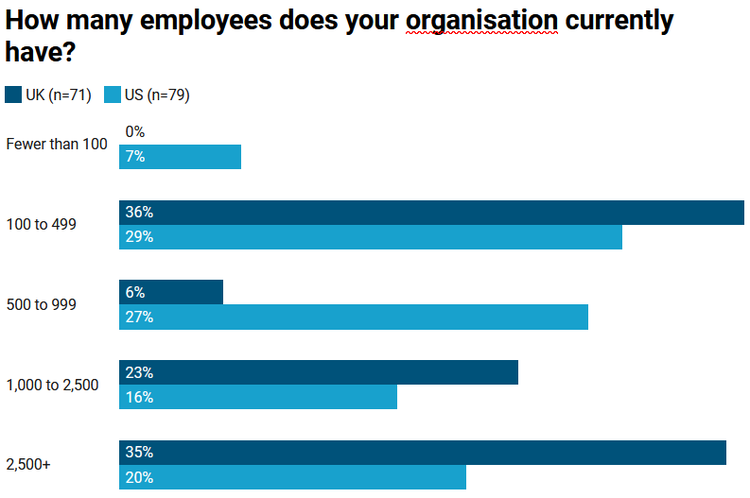
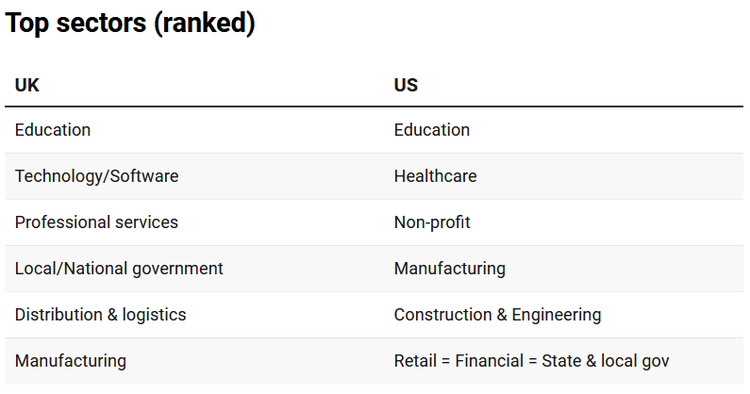
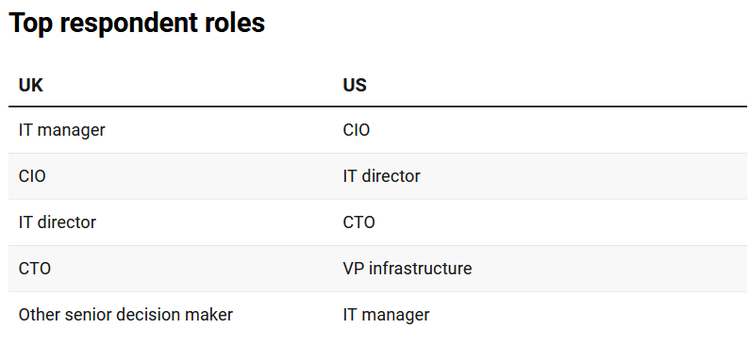
The combined dataset of medium-sized organisations was selected to provide a like-for-like comparison as possible. However, there are differences and the sample sizes are fairly small (See Appendix). Therefore, the results should be treated as indicative rather than definitive, especially where differences are narrow.
That said, they do provide a useful picture of how two similar groups of IT leaders are responding to a common set of challenges.
IT Budgets Are Increasing
In both territories, IT budgets are increasing or holding steady for the majority. However, 54% of US respondents reported a real-terms increase this year, compared with 41% in the UK.
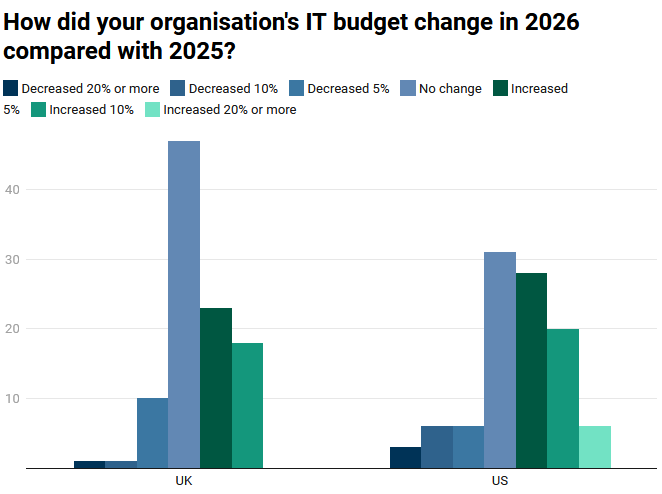
IT budgets are increasing or holding steady for most respondents
US bullishness was apparent in predictions too, with more than half of the American respondents expecting spending increases in 2027, including 30% anticipating growth of 5%, 22% expecting growth of 10%, and 6% anticipating rises of more than 20%.
In the UK, these projections are a more modest 30%, 17% and 3%, respectively.
US positivity is reflected elsewhere in the survey, too. American respondents are more likely to describe themselves as optimistic about prospects for 2027, whereas British respondents are expecting conditions to remain broadly unchanged, for better or worse.
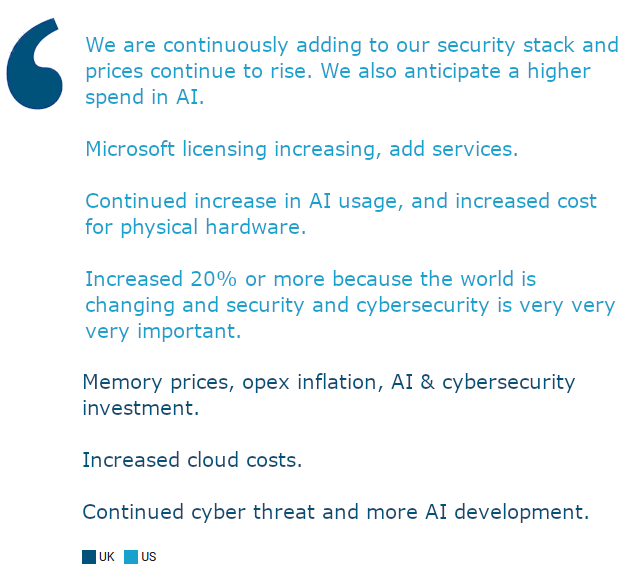
Respondents comment on their IT budgets
Cost Control
Cost discipline remains a dominant concern despite relatively healthy budget expectations, but UK respondents are more
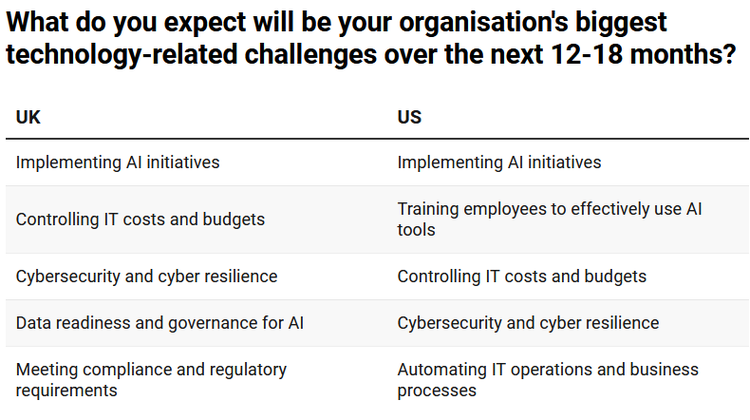
The Biggest Challenges
Concern about rising prices in is found across the piece in the UK, and cost control features prominently among respondents' worries about AI deployment, alongside challenges with return on investment and model accuracy.
By contrast, US respondents appear more willing to treat AI as an operational investment rather than an experimental one. Concerns about cost are less prominent than worries about security, governance and compliance.
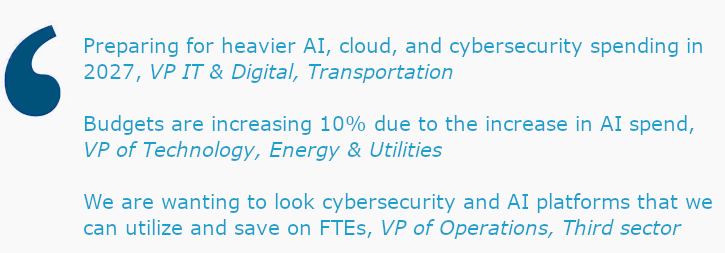
US respondents appear more willing to treat AI as an operational investment
AI Rollouts And Governance
Across both surveys almost all respondents are evaluating AI, piloting projects or deploying systems into production. Only a tiny minority say they are not engaging with AI at all.
The picture in the US and UK is broadly similar with around half of organisations now deploying live use cases.
Broad production deployment remains more common in the US, though, at 9% compared with 6% in the UK sample. However, 6% of UK respondents describe AI as a strategic platform, compared with 2% in the US.
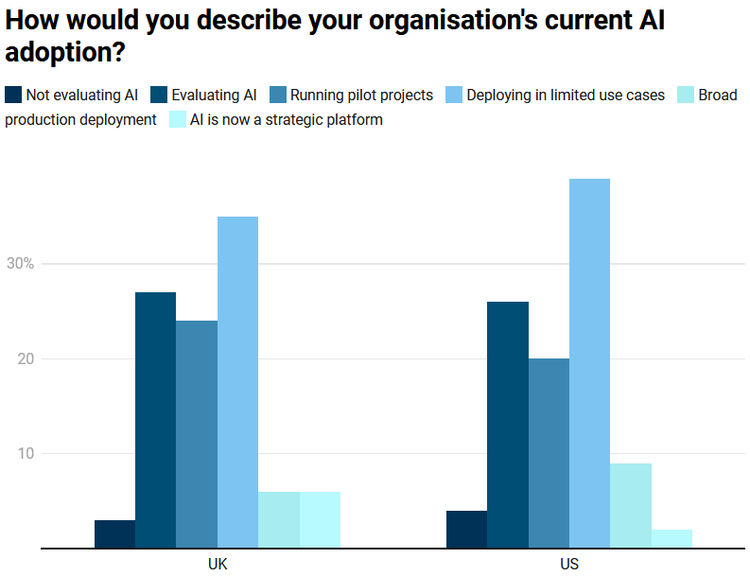
US respondents appear somewhat more advanced in AI
US organisations are ahead in investing in AI governance and training to support the rollouts, with 78% offering formal usage policies and 72% conducting employee training, and 48% operating AI governance committees.
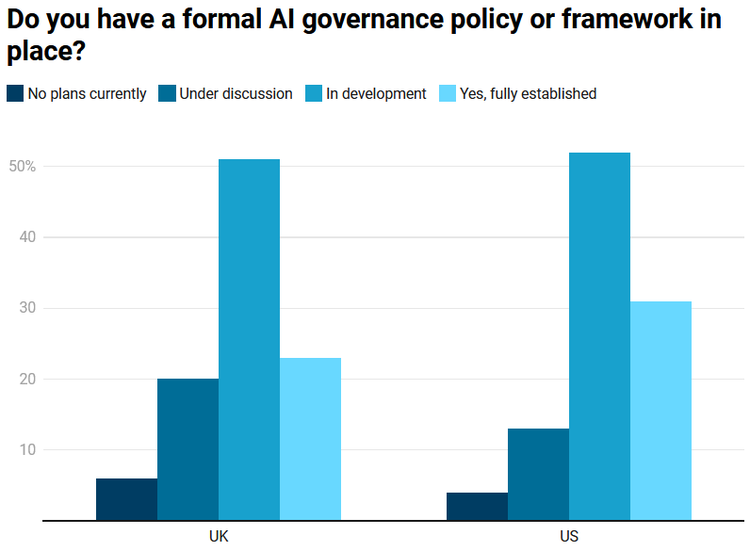
Most are advancing with AI governance policies
A greater emphasis on cost reduction in the UK compared to the US is also evident in answers to the question: “Which AI outcomes would most justify increased AI spending in 2027?”
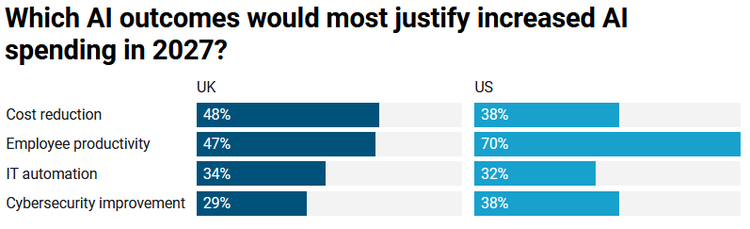
In the UK, cost reduction is a higher priority than productivity
For UK respondents, the top answer is “cost reduction”, whereas for the US – by a large margin - it is “employee productivity”.
This lends weight to the thesis that the US respondents are further ahead with their AI deployments, and are looking to use AI to drive positive benefits, while in the UK the focus currently is on reducing spend.
Cloud Strategy
Cloud remains central to technology strategy in both countries. In the UK, around 15% of the IT budget is consumed by cloud services, with that figure a little higher in the US at a median value of 17%, making cloud the largest single item on the budget for both cohorts.
However, very few organisations are cloud-only, or even cloud-centric. Instead, most occupy a middle ground in which cloud represents between 10% and 50% of overall IT spending.
The surveys reveal different approaches to cloud adoption.
Medium-sized companies often lack substantial IT teams and are therefore prominent users of third-party services, but UK respondents appear more likely to forge direct strategic relationships with cloud providers rather than working through partners. Sixty per cent expect to work with cloud providers in 2027, compared with just 41% of US respondents.
UK respondents are less likely to employ partner organisations than their transatlantic relatives. While cloud providers rank highly, usage of MSPs, VARs, AI consultants and security specialists is relatively modest.
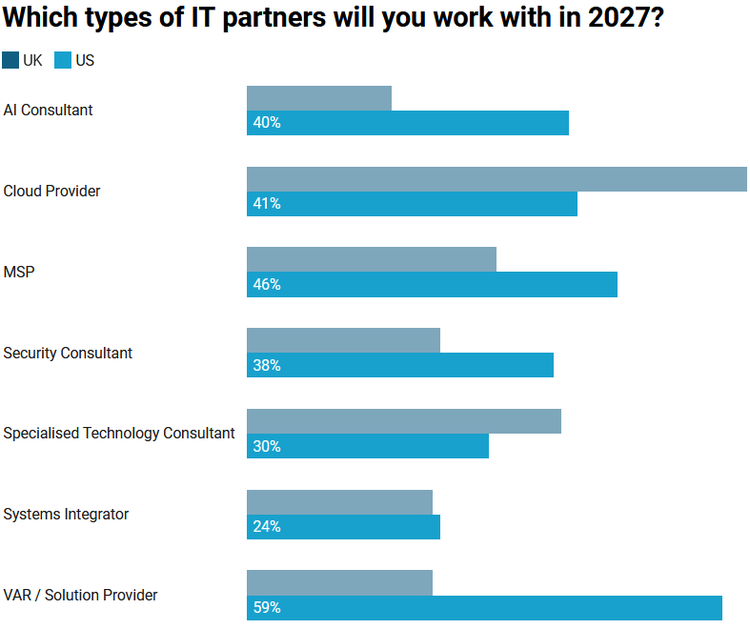
Channel partners are more important to the US cohort
Meanwhile in the US, nearly 60% expect to work with VARs and solution providers in 2027; almost half expect to partner with MSPs and nearly 40% anticipate hiring AI consultants. Security consultants also feature much more heavily among US respondents.
The reasons for the differences between US and UK respondents with respect to partnerships are not immediately clear.
Cybersecurity
The US organisations are spending a higher proportion of their IT budgets on cybersecurity (roughly 10% on average compared with 7% in the UK), with a particular difference apparent in the purchase of cyber insurance.
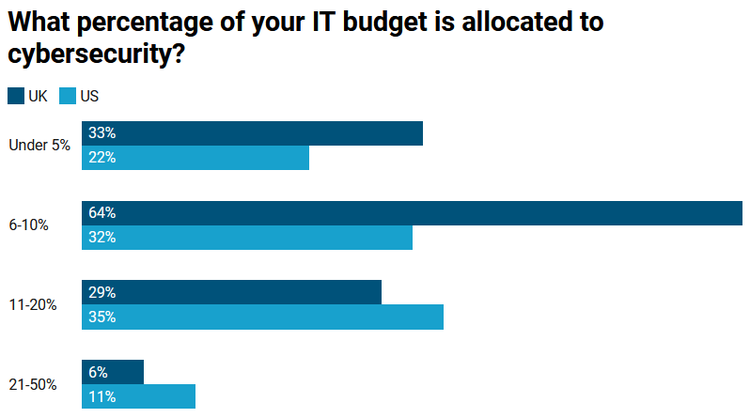
Cyber spend is higher in the US
Among US respondents, 95% purchase cyber insurance, compared with just 59% in the UK. Accordingly, US respondents were more likely to say that their cyber insurance policies influenced their cybersecurity investments.
According to Axis Intelligence, US cyber-insurance policies accounted for more than $9 billion of a total market of around $15 billion in 2025. Many US organisations, treat cyber insurance as a standard part of risk management, whereas UK adoption is lower, especially among SMEs. UK cyber insurance premiums totalled approximately £485 million in 2024, according to Internet Safety Statistics.
Particularly in the US, insurers may require details of an organisation’s cyber defences, and stipulate minimum levels of controls. They may also stipulate certain technologies including multi-factor authentication (MFA), endpoint detection and response (EDR), managed detection and response (MDR), privileged access management (PAM) and the provision of cybersecurity training for staff. Plus, insurers increasingly look for proof that these measures are being operated effectively.
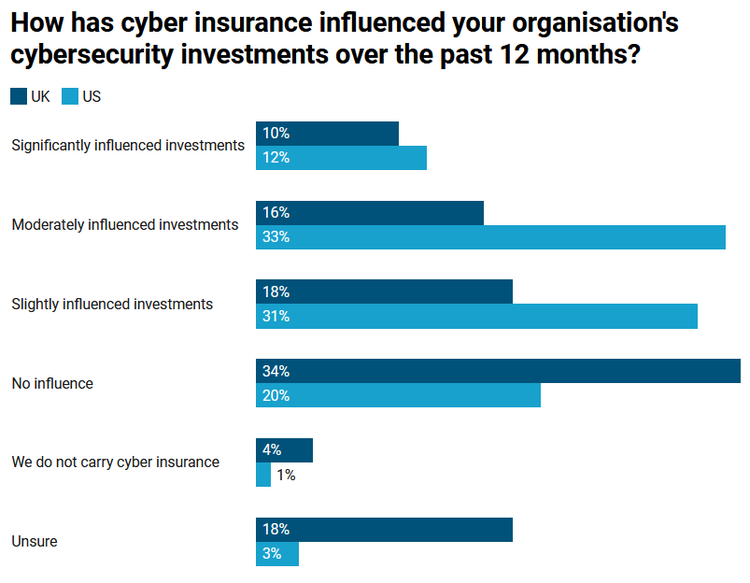
Insurers can influence where the cyber budget is spent
These requirements may lead mid-size organisations to seek the services of third-party providers to fill the gaps they are unable to cover themselves.
While insurers’ demands may help drive up security standards, there’s also the danger that organisations could focus on ticking the compliance boxes rather than on their own unique risks.
The UK NCSC warns organisations not to limit themselves to meeting the insurer's minimum requirements, because simply complying may not adequately protect the business’s core assets.
Sustainability
Energy efficiency is clearly on the agenda in both surveys, but UK respondents appear considerably more focused on the issue of sustainability.
Almost one-third of UK respondents describe energy efficiency as either very or extremely important when evaluating technology purchases and suppliers. In the US survey that falls to around one-fifth.
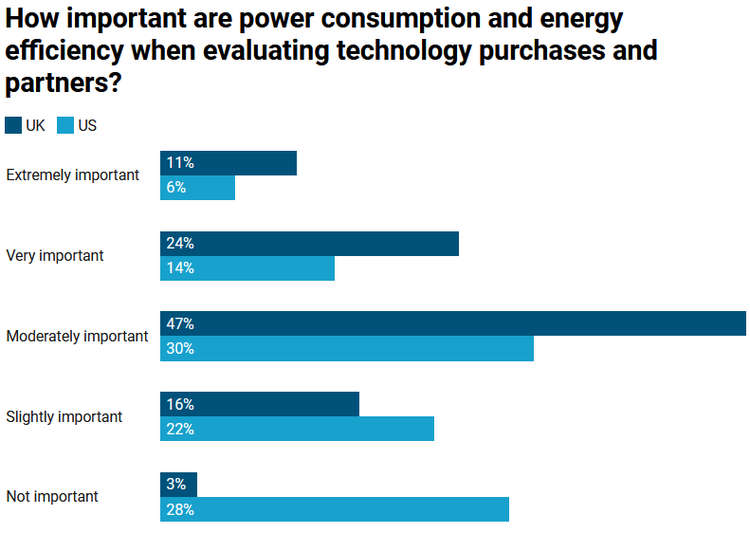
Power consumption and energy efficiency are important to UK IT leaders.
Conversely, more than a quarter of American respondents say energy efficiency is not important, compared with only 6% in the UK sample.
Several factors may explain the differences.
Energy costs have historically been higher in the UK than in the US and that has certainly been the case this year, where the price of electricity has rarely been out of British news headlines. And, possibly serving to bring sustainability issues into sharper focus, Europe was in the middle of its hottest summer on record just as the survey went out.
Regulations are generally stronger in Europe, with many organisations facing sustainability reporting requirements and net-zero commitments. Regulated industries, public sector bodies, education providers and larger enterprises are likewise more likely to include sustainability criteria within procurement processes.
The energy efficiency of technology choices has direct cost implications too.
Overall, the findings suggest that while sustainability is an important consideration, it is often displaced by more immediate priorities such as security, resilience, compliance and AI investment, particularly in the US.
Optimism
We ended the surveys by asking respondents about their levels of optimism for the coming year.
The US contingent comes across as more bullish in general with 24% saying they are much more optimistic for 2027, compared with just 7% of Brits, who were far more likely to select the “mustn’t grumble” option: that 2027 will be about the same as 2026.
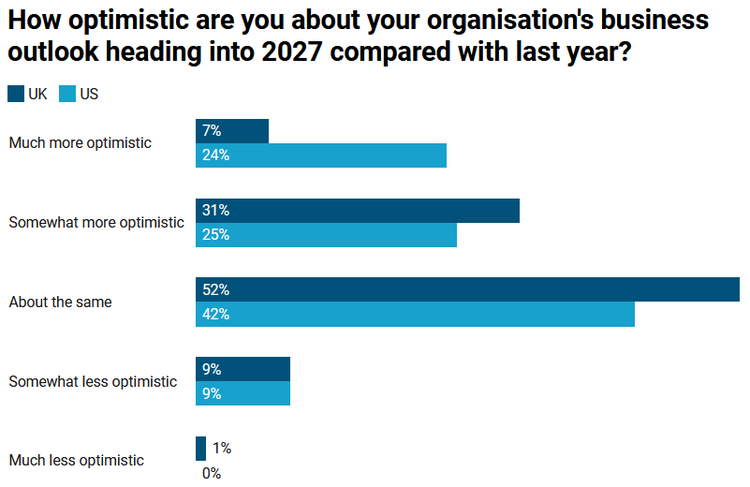
National stereotypes aside, the US economy has been doing better than the UK, albeit driven by a handful of very large companies not featured here.
The US optimism observed appears consistent with higher expected IT-spending growth and a greater willingness to invest in technology-led transformation, while UK respondents place more emphasis on cost control and stability amid economic uncertainty.
Many US respondents see AI, modernisation and operational improvements beginning to deliver tangible benefits. UK respondents, by contrast, more frequently cite taxation, rising overheads, funding pressure and weak economic or political conditions.
The findings suggest that the gap may reflect not only attitudes towards technology, but the wider environments in which organisations are operating.
Appendix
The data
Research was carried out via survey among IT leaders and medium sized organisations in August and September 2026.
This article originally appeared on MES Computing's sister site Computing.