MES Computing IT Leaders Spending Intent Survey 2026: AI Ambitions Meet Operational Realities
IT leaders plan continued investment in AI, cybersecurity and modernization, but concerns over governance, skills and business value are shaping a more measured path

Midmarket IT leaders are preparing for another year of technology investment, but their priorities suggest a growing focus on execution rather than experimentation.
Results from the 2026 MES Computing IT Leaders Spending Intent Survey show organizations continuing to invest in artificial intelligence, cybersecurity, infrastructure modernization and cloud technologies heading into 2027. Yet the data also reveals significant concerns around AI governance, data quality, regulatory compliance and skills gaps.
Many respondents are pursuing AI through pilot programs and targeted use cases rather than sweeping business transformation projects.
Several findings from the 2026 MES Computing IT Leaders Spending Intent Survey reflect themes discussed by Gartner analyst Mike Cisek during presentations and research focused on midsize enterprise technology priorities at MES Fall.
According to Gartner’s research, organizations should favor initiatives that produce practical business outcomes, incorporate risk management and integrate with existing operations over sweeping transformation efforts.
Methodology: MES Computing surveyed North American-based midmarket IT decision-makers between August and September 2026. Full methodology is available at the end of this report.
Key Findings From MES' Research
Cybersecurity Remains The Foundation Of Midmarket IT Investment
Across nearly every respondent segment, cybersecurity and cyber resilience emerged as the most common investment priority for 2027. Respondents repeatedly pinpointed cybersecurity portfolios, identity management, resilience initiatives, managed security services, as well as governance projects as primary focus areas for IT budgets.
While AI captured significant executive attention, survey participants consistently ranked cyber risk, compliance requirements and operational resilience as top of mind for technology concerns.
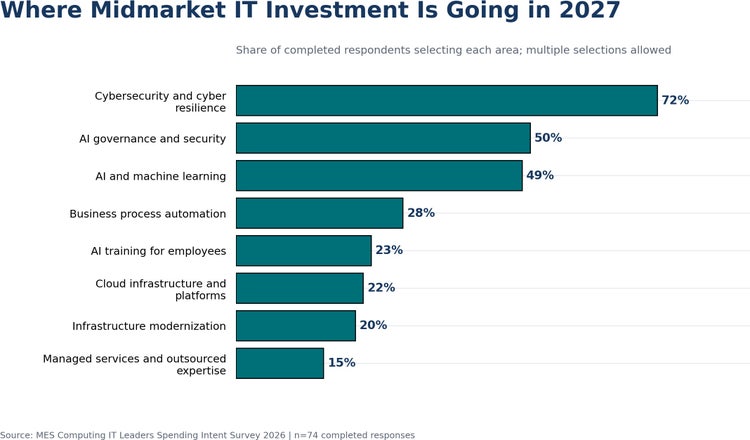
Takeaway: AI may be dominating news headlines, but midmarket CIOs and other decision-makers continue to view security as a non-negotiable business requirement rather than a discretionary investment.
AI Adoption Is Growing, Yet Most Organizations Remain In The Pilot Phase
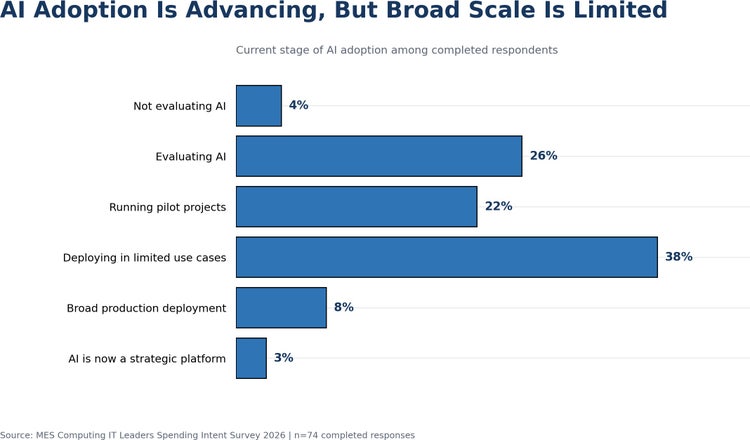
Most respondents described themselves as "evaluating" AI – running pilot projects or deploying AI within limited use cases rather than broadly transforming business operations.
Common areas of investment by midmarket IT leaders include:
- Employee copilots
- Business Process Automation (BPA)
- IT operations automation
- Knowledge management
- Data analysis
- Security operations
While agentic AI appears frequently among planned investment categories, relatively few organizations described widespread production deployments.
Takeaway: Midmarket organizations are moving deliberately, not aggressively. Leaders want measurable productivity and operational gains before committing to larger AI investments.
This closely reflects Gartner's guidance that organizations should focus on "everyday AI" (such as AI that may be embedded in existing line-of-business applications) and incremental improvements rather than on large transformational plans.
Governance Is Becoming The Next AI Battleground
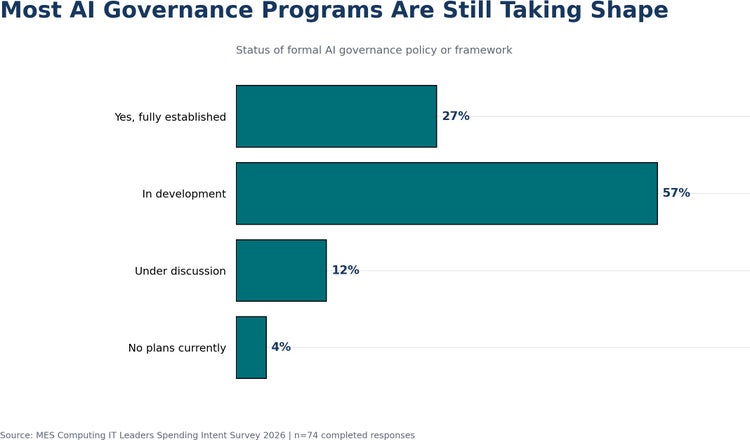
One of the strongest themes in the survey is the rapid emergence of AI governance initiatives.
Respondents frequently cited investments in:
- AI usage policies
- Employee AI training
- Governance committees
- Legal and compliance reviews
- AI monitoring tools
- Security controls
- Data governance programs
In addition, governance, compliance, hallucinations, data quality and lack of internal expertise consistently ranked among the most significant AI concerns.
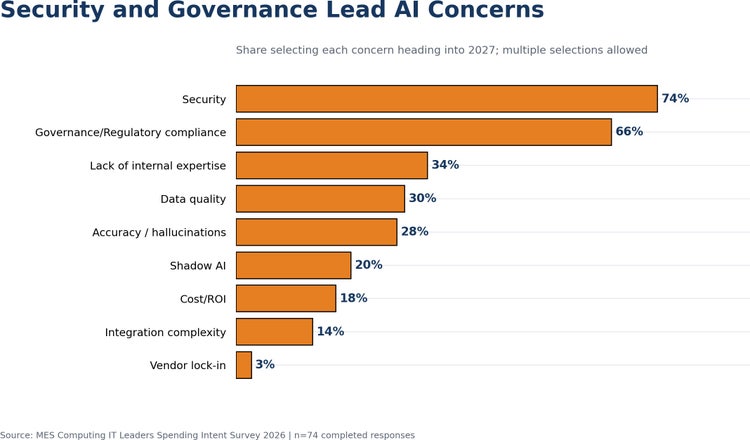
Takeaway: The challenge facing midmarket organizations is no longer whether employees will use AI. They are. The challenge is governing AI effectively.
This finding mirrors Gartner's observation that organizations must have operational frameworks, governance controls and orderly data in place before expanding AI use cases.
Skills Gaps Threaten Success With AI
Among future challenges, respondents repeatedly reported:
- Implementing AI initiatives
- Training employees to use AI tools
- Recruiting and retaining skilled IT professionals
- Data readiness and governance
- Modernizing legacy environments
Numerous written responses described concerns about internal expertise, organizational readiness and keeping pace with technological changes.
Takeaway: The biggest obstacle to AI adoption may not be technology. It may be people.
Gartner's presentation emphasized that business adoption, change management and skills development will likely determine whether AI projects succeed or crash.
External Partners Remain Critical
Many respondents indicated plans to work with:
- MSPs
- VARs and solution providers
- Security consultants
- AI consultants
- Specialized technology consultants
- Systems integrators
Takeaway: The findings suggest midmarket organizations continue to rely heavily on external expertise.
This echoes Gartner's recommendation that midsize organizations remain technology consumers rather than attempting to develop extensive specialized capabilities themselves.
The Midmarket CIO's Challenge For 2027
The survey highlights a tricky balancing act facing technology leaders. They must:
- Continue modernizing infrastructure.
- Strengthen cybersecurity and resilience.
- Establish AI governance frameworks.
- Improve data quality and readiness.
- Upskill employees.
- Demonstrate measurable business value.
All while controlling costs and navigating economic uncertainty.
The result is a more pragmatic approach to innovation than the broader technology market often portrays.
Midmarket organizations are not pursuing AI for the sake of it; they are focused on adopting AI where it can improve productivity, automate routine work, strengthen security and support better business decisions.
Conclusion
The 2026 MES Computing IT Leaders Spending Intent Survey suggests that AI is becoming a fixed priority for midmarket organizations, but not at the expense of foundational IT disciplines such as cybersecurity, resilience and infrastructure modernization.
Methodology
MES Computing surveyed North American technology decision-makers between Aug. 3 and Sept. 6, 2026. Respondents represented organizations across multiple industries, with the majority employing between 100 and 2,500 employees. The findings reflect participants' technology priorities, investment plans and business concerns heading into 2027.