AI Is Breaking Traditional IT Budget Models: 5 Ways To Rethink Budgeting
One expert explains why IT leaders can no longer budget based on "humans" and "heads."
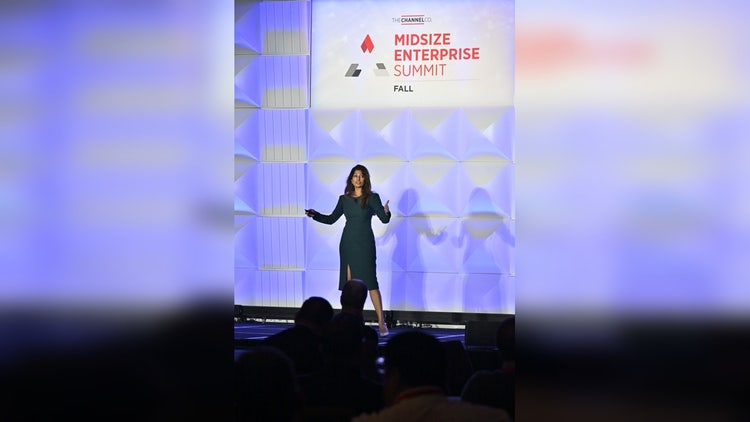
(Image: Nadia Hansen, AI strategist, educator and founder of CLV Enterprise Inc. on stage at MES Fall)
For decades, IT budgets have been built around a predictable model--organizations have traditionally paid for technology based on human usage.
AI has completely upended that model, according to Nadia Hansen, an AI strategist, educator and founder of CLV Enterprise Inc.
During her presentation at this year's MES Fall conference, Hansen argued that AI agents break traditional budgeting models because organizations are now paying for workflows, token consumption, tool calls, context retrieval and autonomous actions.
[RELATED: While Vendors Push AI Transformation, IT Leaders Focus On Practical Gains]
In other words, AI introduces operating costs that fluctuate based on how much work AI agents actually do.
Hansen delved into specifics about how AI has transformed the AI budget process, and also offered guidance as IT leaders rethink their budgeting strategies to account for AI.
Most Organizations Are Budgeting For AI Incorrectly
During her session, Hansen repeatedly noted that many companies are still budgeting for AI as though it were just another software license – a potentially costly mistake, she warned.
[RELATED: MES Computing IT Leaders Spending Intent Survey 2026: AI Ambitions Meet Operational Realities]
"They're still budgeting like we're budgeting for software licenses. We're budgeting for heads. We're budgeting for humans. But with agents into play, things have changed the conversation," Hansen said.
Industry research also highlights AI's economic impact. A recent study from McKinsey found that "AI is consuming up to a third of change budgets while also increasing run costs" in enterprise budgets.
As AI reshapes IT budgets, there is very real potential that midmarket organizations may underestimate costs because agentic systems consume resources continuously as workflows execute.
Governance Is Becoming A Financial Issue, Not Just A Security Issue
Hansen also strongly emphasized that governance is now tied to spending. While AI governance strategies often focus on controlling AI, Hansen suggested that understanding AI consumption is just as critical.
[RELATED: AI Data Governance: What Midmarket IT Leaders Must Prove In 2026]
Governing AI consumption should include insight into:
-usage attribution
-anomaly detection
-workflow ownership
-token caps
-spend monitoring
Budget For Workflows Instead Of Users
IT leaders must overhaul outmoded budgeting strategies, Hansen suggested.
"You really have to start estimating what it is going to cost from a token consumption perspective for this workflow to execute from point A," she said.
"We have to rethink the scale and plan for the effort it's going to take."
Hansen made clear that the old "$ per user" model has given way to a "$ per workflow, per ticket resolved, per customer interaction" model.
Token Management May Become An IT Discipline
A decade ago, enterprises raced to the cloud. While cloud computing promised a pay-for-what-you-use pricing model, many organizations at the time were also caught off guard by unexpected charges related to idle servers or mismanaged workloads, for example.
The complexities associated with cloud costs made cloud computing management a new part of IT operations.
AI token management is headed down the same path, according to Hansen.
"We're going to have a line item in our budgets that says token budget, token consumption," she said.
Organizations Need To Stop Budgeting Once A Year
AI spending requires constant monitoring, Hansen argued, calling it "a live exercise."
"The old way of budgeting was, we set the budget ... Now we're constantly monitoring, constantly watching and seeing and making sure and adjusting."