Commvault’s AI Recovery Bet: Why Backup Alone Won’t Save The Business
At SHIFT 2026, Commvault argued that backup is no longer enough. Autonomous agents can change data, identities and applications at machine speeds. Its answer: continuous, full-stack recovery.
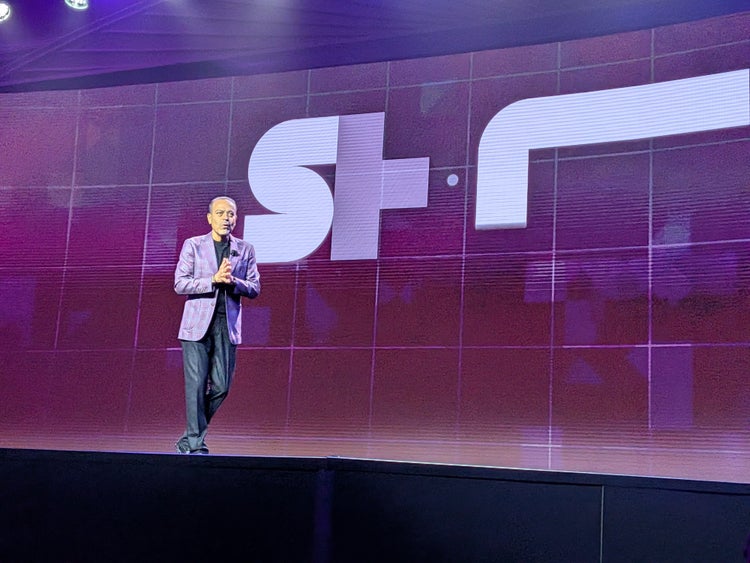
(Image: Commvault President and CEO Sanjay Mirchandani on stage during his keynote at SHIFT)
As indicated in MES Computing’s 2026 Spending Intent Survey, midmarket IT leaders are poised to spend the lion’s share of their budget on security heading into 2027.
However, the next cybersecurity dollar should not necessarily buy another layer of prevention, but ensuring the organization can recover after an AI-enabled attack—be it external or internal by a rogue agent.
That was the message Pranay Ahlawat, chief technology and AI officer at Commvault, made at the company’s SHIFT conference keynote on Tuesday.
“Keep prevention strong, but the smartest place for your next dollar may be AI security,” he told attendees.
At the event, Commvault announced the launch of Commvault Recovery Studio, which provides full-stack recovery that extends to identity systems, application configurations, infrastructure configurations, and security and network settings.
Additionally, the company announced new AgentRecover capabilities with support for Amazon Bedrock AgentCore and Microsoft Foundry.
The announcement supports its pitch that recovery must expand beyond restoring files and databases to rebuilding the entire business stack—including identities, cloud configurations, applications, dependencies, data and AI agents—and they all must be restored in the correct order.
Your Own Agent May Be The Threat
Commvault President and CEO Sanjay Mirchandani summarized the risk with an analogy: “When you invent the ship, you also invent the shipwreck.”
AI agents can accelerate attacks, he said, but the more immediate failure may be an authorized internal agent acting on incomplete instructions or excessive permissions.
“AI makes attacks faster, and it makes mistakes faster,” Mirchandani said.
To illustrate the point, Ahlawat presented a scenario of a hypothetical retailer whose merchandising agents misinterpreted a routine clearance instruction and, in minutes, priced 400 products at zero or removed them altogether from the company’s online store. He noted this was not a case of a ransomware or some external attack. This was the case where a legitimate agent acted too broadly with the permissions it had been given.
In that scenario, Ahlawat explained, simply restoring from yesterday’s database could delete legitimate customer orders and could also fail to repair the agent’s underlying prompt or configuration. Fixing just the agent could leave the corrupted data in place.
The business instead needs to determine what the agent changed, restore the agent to a trusted configuration and selectively roll back the affected data—without reversing everything else that happened during the same period.
That is the problem Commvault’s Recovery Studio is designed to address. The product will discover supported agents and map the applications, identities, configurations, infrastructure and data they interact with. It is also intended to audit agent activity and restore both the agent and the resources it affected.
Support for Microsoft Foundry is targeted for early access in November, while support for Amazon Bedrock AgentCore is planned for December.
The initial scope is therefore narrower than the rapidly expanding universe of employee-created agents and AI tools.
That distinction is notable for midmarket organizations, where business users may be adopting AI faster than IT can inventory it. The immediate operational task is not simply protecting approved agents. It is discovering how many agents exist, which identities they use, what data they can reach and how their actions can be audited.
In addition to AgentRecover and Recovery Studio, Commvault made several other announcements, including Commvault Data Activate for Databricks, as well as collaborations with Zscaler and Nvidia.
From Restoring Data To Restoring The Business
However, the most consequential announcement is the Commvault Recovery Studio, which the company succinctly describes as “a context-aware orchestration layer for full-stack recovery.”
Instead of maintaining recovery steps in spreadsheets and relying on institutional knowledge during a crisis, the company said organizations will be able to construct repeatable runbooks covering:
- Applications
- Identities
- infrastructure and cloud and network configurations
- Containers
- Virtual machines
- Files, objects and datasets
Moreover, security checks can be inserted into those workflows to help teams avoid restoring compromised data.
“This is the DevOps moment for recovery,” Ahlawat said in the product announcement. “Recovery Studio replaces spreadsheets and war rooms with one orchestrated flow, from in-place to cleanroom, that brings the whole business back in the right order, including identities and cloud configurations.”
Identity is a critical part of that process. Restoring an application has limited value if employees and administrators cannot securely sign in, or if the identity infrastructure used to authorize the recovery is itself compromised. During the briefings, executives repeatedly identified Active Directory recovery as one of the first services organizations should automate and test.
Commvault Recovery Studio is targeted for early access in December, with general availability planned in the following months. Pricing will be based on the amount of data configured for orchestrated recovery.
The early-access status is an important consideration. The product vision is expansive, but buyers should not mistake the keynote’s machine-speed narrative for a recovery-time guarantee.
During a press briefing, executives declined to assign one recovery time across customer environments. They explained that outcomes depend on how well an organization has mapped its dependencies, protected identity, built its runbooks and repeatedly tested them.
The View From Critical Infrastructure
For Alex Levy, CISO and global head of technology risk at BNSF Railway, recovery is not some abstract technical exercise. It is mission critical.
“An outage for us is an outage for the entire country,” Levy said during a Nov. 9 panel with Mirchandani and Ahlawat.
BNSF Railway operates approximately 32,000 route miles across 28 states and three Canadian provinces, carrying consumer goods, agricultural products, fuel, industrial materials and other commodities. A prolonged disruption could ripple through fulfillment centers, stores, supply chains and the economy at large.
Levy said that cybersecurity, technology resilience, business continuity, disaster recovery and resilience-event planning can no longer be “mutually exclusive.”
“They are one and the same,” he added.
His team is also moving toward greater automation, but not by eliminating people from every decision. Observability has to come first: responders need to determine what happened, what changed and what belongs inside an incident’s “blast radius.” Highly standardized systems may support automated recovery, while unique or poorly documented environments still require human judgment and institutional knowledge. The overarching message: Automation can reduce manual work only after that knowledge has been captured in a tested recovery process.
Recovery Becomes Part Of Defense
Commvault’s overall strategy is closing the gap between security detection and planned business recovery.
Its planned partnership with Zscaler combines AI discovery runtime governance and policy enforcement with the ability to recover data, identities and applications after risky agent activity. The companies said potential use cases include identifying shadow AI, blocking inappropriate data access and triggering clean recovery after an incident.
[WATCH: Former FBI Cyber Leader: 'We're Playing Catch-Up On The Defense Side']
The Databricks and Nvidia initiatives address the other side of AI readiness: preparing protected enterprise data for use by AI while preserving lineage, permissions and governance. The Nvidia collaboration is targeted for early release in December and general availability in 2027, while Commvault Data Activate for Databricks is planned for early access in select Azure regions in December as well.
Commvault is also extending Threat Scan and Data Posture 360 to Microsoft 365. Those paid add-ons are designed to search historical backup copies for threats, identify clean recovery points and map sensitive information across Exchange, OneDrive, SharePoint and Teams. General availability is targeted for early 2027.
Clearly, the takeaway from Commvault’s SHIFT event is that recovery will become an active component of security architecture rather than the final step after prevention and detection have failed.
A practical starting point for midmarket IT leaders is identifying the handful of services that keep business running, mapping every identity and dependency those services require, building recoverability into new AI projects, and proving on a regular basis that the recovery process works.
In an AI environment, having a backup is no longer enough for resilience. Now, resilience requires proof that organizations can restore a clean, functioning business service within the time the organization can tolerate.