Where AI Agents Are Finding Their Economic Case In Midmarket IT
A new report suggests certain business processes are providing the best returns on automation investments.

Mention “AI agents” in a room of IT leaders and you’ll likely split the room. While some remain hesitant to entrust meaningful business functions to autonomous systems, others see agents as the first source of real leverage lean IT teams have had in years.
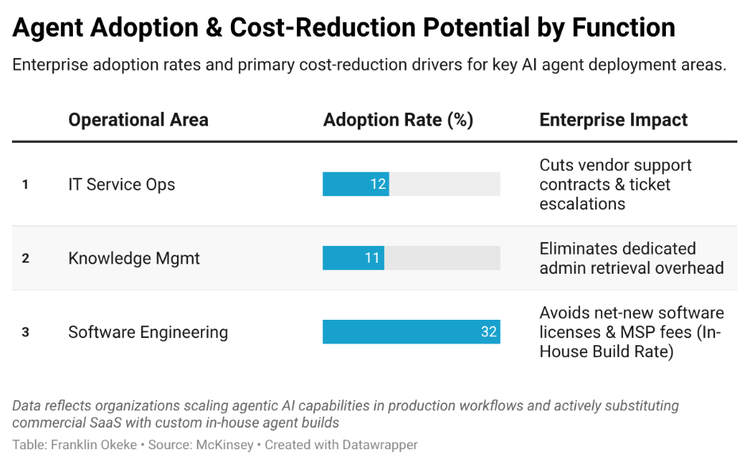
McKinsey's latest State of AI survey suggests neither perspective tells the full story. Agentic AI adoption is accelerating, with 32 percent of organizations reporting they have already decided against at least on software purchase because AI coding tools allowed them to build similar functionality in-house. But adoption remains concentrated in a relatively small number of business functions, giving IT leaders a clearer picture of where agentic automation is delivering measurable returns.
So where can AI agents make the strongest economic case for midmarket IT organizations?
The IT Workflows Where Agents Can Pay Off
McKinsey’s research suggests that midmarket organizations looking to maximize the return on agentic automation should consider these workflows as early candidates:
IT Service Operations
IT leads every function McKinsey tracked, with 12 percent of respondents reporting agents already at the scaling phase. Respondents say they’ve deployed agents to handle repeatable service work such as user support, incident triage, knowledge retrieval and routine troubleshooting, and by so doing, reducing the volume of work that requires human intervention or outside support contracts. Deloitte also identified user support, incident reporting and cybersecurity protocols among the repeatable IT processes increasingly suited to automation and most likely to produce a working pilot within a single budget cycle.
Knowledge Management
Knowledge management follows closely behind, with McKinsey tracking active agent deployment at 11 percent. These agents help organizations search, summarize, and retrieve internal documentation, contracts, policies, prior project notes, the kind of material that used to require either a dedicated internal team or a costly enterprise search platform to make usable. That opens a path for smaller IT teams to automate administrative work that might otherwise sit with business operations staff or external content service providers.
Software Engineering
Nearly one-third of McKinsey respondents said their organizations had decided against buying at least one software product or feature because they could build the functionality internally using AI coding agents. For a smaller company, that could translate to building lightweight internal applications, workflow tools or integrations using AI-assisted development tools.
The Strategic Takeaway
The current market data does not settle whether AI agents deserve absolute hype or total skepticism. Instead, it offers a pragmatic blueprint for resource-constrained organizations: agentic deployment should not be treated as an all-encompassing platform transformation, but as targeted surgical intervention.
To capture immediate operational leverage while minimizing risk, midmarket tech leaders should evaluate candidate workflows against five core criteria before allocating budget:
- High Volume & Frequency: Is the task recurring, predictable, and frequent enough to generate meaningful time savings? (e.g., Tier-1 ticket triage, access provisioning, compliance log reviews)
- Explicit Financial Drag: Does the workflow carry direct, measurable costs? (e.g., dedicated headcount, overtime, external MSP retainers, or seat-based SaaS fees)
- Standardized Knowledge Base: Is the process well-documented and governed by clear rules in a way that minimizes the risk of edge-case failures?
- Low-Risk Failure State: Can an error be caught quickly without critical system downtime or security compromises? (e.g., internal documentation retrieval vs. production database deployments)
- Measurable Audit Trail: Can the agent's output be easily validated and audited against existing operational benchmarks?
If a potential use case checks every box, it may represent an ideal candidate for a low-cost, high-ROI pilot capable of demonstrating measurable business value within a single budget cycle.