MES Fall 2026 Kicks Off With New Leadership Challenge: Stop Rewarding 'Push-Through' Culture
Opening day speakers connected the familiar pressures facing midmarket IT leaders with a broader leadership question: How can organizations build resilient teams without pushing overwork?
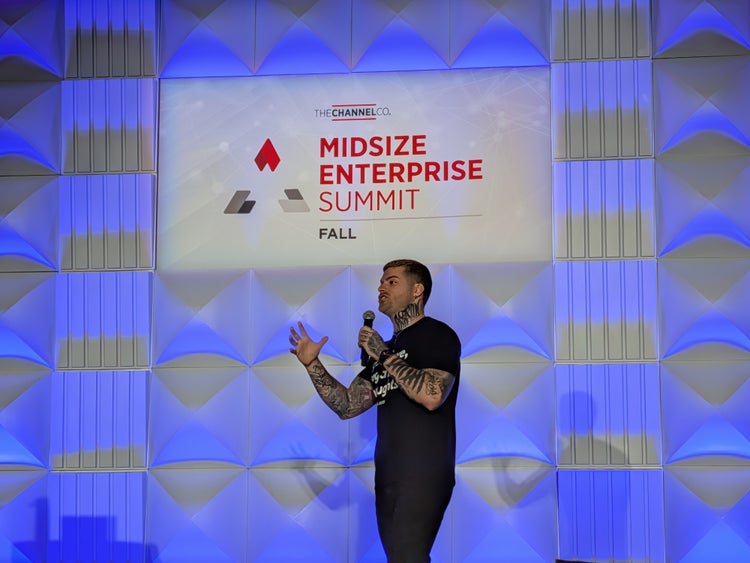
(Johnny Crowder, founder and CEO of Cope Notes, on stage at MES Fall 2026, in Marco Island, Fla., Sept. 20, 2026)
MES Fall 2026 opened Sunday in Marco Island, Fla., with an acknowledgement of pressures familiar to many midmarket IT leaders: limited staff, constrained budgets, growing demands from senior leadership and new expectations surrounding artificial intelligence.
During the attendee orientation, IT leaders in the audience were asked to remain standing if they had all the staffing and budget they needed. Most sat down.
Additional questions about whether boards fully understood their departments' work and whether their teams had been given new AI responsibilities saw most of the leaders standing, take a seat.
The exercise was intended to show that almost all of the 150 leaders gathered at that session were facing the same challenges.
However, the opening keynote pushed past the conversation about operational pressures facing IT departments. Johnny Crowder, a mental health, resilience, and company culture expert, and founder and CEO of Cope Notes, challenged attendees to consider what their organizations recognize and reward.
Crowder argues that workplaces often celebrate employees who skip lunch, work late and continue pushing despite mounting strain. Those behaviors may look like dedication, he said, but they can also reflect a culture in which employees expect to be "applauded if they push through or punished if they don't."
Later in his keynote, Crowder said resilience should not be defined solely by how much pressure an employee can withstand. Rather, leaders should create conditions where people can acknowledge difficulties, seek support and make sound decisions before a manageable problem becomes a crisis.
Crowder drew a contrast between what he described as a tendency of society to equate extreme perseverance with the Antarctic explorer Ernest Shackleton. When Shackleton's ship, the Endurance, became trapped in ice, Crowder noted, Shackleton abandoned ship to bring his crew to safety,
"Getting home took endurance, too," Crowder observed.
Building Trust Before A Crisis
Crowder offered several ways leaders can make mental health a regular part of workplace culture without waiting for an emergency or relying exclusively on formal programs.
His first piece of advice: Ask employees questions that are not about work.
Small conversations about a weekend activity, a hobby or an employee's interests can show that a manager values the individual beyond immediate assignments and output, Crowder said. That foundation can make it easier for an employee to speak honestly if a more serious problem arises.
"These little micro-interactions matter because they set a precedent that you don't only care about work," he said.
He also advised leaders to make mental health part of regular workplace language rather than addressing it only during an awareness campaign or after a crisis. A single email reminding employees about available resources is unlikely to change whether workers feel safe discussing difficulties, he said.
Crowder shared his own experiences. He described becoming visibly emotional during a company meeting while his family was experiencing a crisis. At first, he feared the moment would damage his credibility, but individual members of his own team subsequently contacted him to offer help and share their own difficulties.
That experience, he said, made communication within the organizations more candid.
"People are relieved when they can see that you are human," Crowder told attendees.
From Peer Networking To Leadership Practice
The keynote's message also reinforced the event's opening emphasis on peer connections. During the orientation, attendees were encouraged to use the gathering to discuss the staffing, budget, board communication and AI pressures they shared, rather than treating these challenges as isolated organizational issues.
Crowder left the audience with a practical exercise: choose another person sitting at their table and schedule a conversation during the conference about something other than work.
"The point of getting everybody in one place is to get you out from behind your computer," he said.
Follow live coverage of #MES Fall on MES Computing's LinkedIn and WhatsApp channels.